Sunday, August 4, 2019

Dawn of Perim: Where it All Began


I'll be taking a look at Dawn of Perim (DoP) in this post. It's the first set from the original Chaotic TCG series. If we break down the contents of the 232-card set, we get this:

Types                        Rarities
86 Creatures                              67 Common
 -28 Overworlders                     67 Uncommon
 -28 Underworlders                   38 Rare
 -15 Danians                              32 Super Rare
 -15 Mipedians                          12 Ultra Rare
49 Attacks
29 Battlegear
38 Mugic
30 Locations

Shown here is the best creature in the entire game: Gespedan.
Look how strong and fast he is. He has style, he has grace, he is Miss United States.

Actually I just chose him at random. Notice the black icon in the top right corner. That symbol signifies that the card is part of the DoP set, and the color classifies Gespedan as Common. So he's actually not Miss United States, he's a peasant. A commoner.

If you notice the breakdown of creature tribes, you'll see DoP dramatically favors Over- and Underworlders. Why was this choice made? Why were Danians and Mipedians hot trash? The answer is that they got their "own" sets following DoP. I disagree that this really justifies leaving two tribes fairly useless for the opening era of the game, but that's neither here nor there. It was 2007, a more simple time full of more simple people.

DoP introduces the world to Chaotic. It comes with many of the mechanics that stick with Chaotic throughout its history, such as Support, Swift, Range, Element X, Intimidate, etc. Overtime, many of the cards from DoP have fallen by the wayside, as power creep in newer sets leaves them in the dust.

Some cards have withstood the test of time, and have even been reprinted in later sets. For example, many of the DoP attack cards, like Torrent of Flame, Iron Balls, and Riptide, still offer enough damage or utility to stay relevant.
For only 1 build point, you can shut down
that dumb Mugic shit

While the uses for DoP cards may be niche, the should never be discounted when building a deck. Especially if you don't have access to cards from later sets, DoP cards can still offer quite a bit.


Lord Van Bloot, Chaor, and Maxxor still bring enough damage, stats, energy, and ATTITUDE to make into a contemporary top-tier team.

What do those cards have in common?
The fact that they aren't common. They're Ultra Rare (UR). Of course the UR cards are going to be the best. Here are the UR cards in DoP:


Actually super spooky
Small but feisty. Ball shaped
Honestly not a fan.
Why the hair?
BAMF
For the Bodal bois out there
Actually is more useful
in later sets
Looks good on a warbeast,
very slimming
I can't imagine this has
seen much use
Everyone needs more
Fortissimo
Is the Underworld known
for its backup plans?
Why sideways?
Like, honestly. Why are
 Locations like this.

A Chaotic Comeback?

It's been a long time since we've heard anything about Chaotic, but the time has come. Bryan Gannon, one of the former execs involved with publishing Chaotic back in the day has announced a return of some kind is in the works. What this really means for the Chaotic IP has yet to be seen. Personally, I'm skeptical that a new product will be a straight relaunch of the old series. Of course, I would love it if my collection was completely worthless, but I'd love it more if the game came back in any form. As long as it keeps the heart of the story, the gameplay, and the feeling, a Chaotic Comeback would be a welcome part of 2019.

Monday, May 8, 2017

Locations: Where Even Are We?


Ah yes, beautiful, scenic Lake Ken-I-Po... an unfortunate name for a wonderful place. Chaotic is filled with unique and interesting Locations that act as the "Where" part of each turn in the game.

Both players get 10 Location cards in  separate little deck on the side of the table. At the beginning of every turn, the Active player (as in the player whose turn it is) flips over the top card of their location deck and that new Location replaces the previous one. All Location effects are active as soon as the Location is revealed, before combat begins.


Initiative

One of the most important things Locations do is decide who gets to throw the first attack in a fight. Initiative tells you who gets to go first. Lake Ken-I-Po, for example, tell you to compare the 2 engaged Creatures' Power stat, and the Creature with the higher Power gets to move first.

Mipedim Lounge asks you to look for a Creature Ability, Invisibility. So a creature with Invisibility gets to move first! When you tie with your opponent's Creature for Initiative, the Active Player wins Initiative.

Mirage

Mirage is a pretty unique Location ability. When a Location with Mirage is the Active Location, the Mirage ability is NOT used. Once the turn where that Location was Active is over, the Mirage Location is placed on an empty space on the field. If a fight occurs on that spot, the Mirage ability becomes active, along with any effects of the Active Location. Only 1 Mirage can be on the field at a time, so when a new Mirage finishes its time as Active Location, you must place any Mirage on the field at the bottom of your Location deck.


Locations can have a pretty profound impact on fights, and choosing the right 10 Locations is key to any deck. Think about what abilities benefit your creatures and who can take advantage of Initiative.


Sunday, May 7, 2017

Expend: Ablility Spotlight

Expend: The Renewable Resource That the World Needs


This brilliant ability was introduced in Chaotic's final set, Alliances Unraveled (AU). Expend is a Activated ability, meaning it requires a cost be paid in order to get the benefits of the effect. In this case, a creature expends an element!

The great part about Expend is that, since an Element is scanned on to the card, a creature will regain that Element, like it would regain Energy or Discipline scores at the end of every turn.

For example, Donmar here has Expend Water: Heal 10 damage to target creature.

To heal an ally (or an enemy if that's your poison) Donmar can give up his Element of Water for the turn. He does not need to be engaged in combat to use this ability, and at the end of the turn, he gets Water back and can use his ability again!

Hypothetical
Donmar, Tablet Translator is equipped with a Liquilizer. He uses Expend Water to heal himself 10 energy. He can sacrifice the Liquilizer, regain Water, and use his ability again, all on the same turn. Which is to say, that as long as a creature has the specified Element to give, you can use the ability.

Now here's a case where the creature must be engaged to use Expend. Savitsa needs to be in combat to use his Expend ability, which may make you think twice before committing to it, since Savitsa wouldn't be able to use anymore Fire attacks. But there's always the case where that might be exactly what you want.

For example, Savitsa against a creature like Raznus, Ambassador to the Danians. Raznus has Fireproof 10, meaning he gains 10 Energy at the beginning of combat when the opposing creature has Fire. If You Expend Savitsa's Fire before Fireproof takes effect on in the Burst, Raznus gains no Energy!

It's niche, but there's always a case where it could be the difference between winning or losing a fight.


Khybon, Magma Dam Overseer is an interesting and unique example of an Expend ability, but the principle is always the same. Kybon can give up Fire for a Magma counter which, once he has 5, can be used to deal 40 damage to all engaged creatures.

Notice it doesn't say Kybon needs to be engaged in combat to use any part of his ability! This could be a great way to deal a huge chunk of damage to your enemy if you're creature can take the hit.


Some battlegear like the Quranium Pendant give creatures new Expend abilities.

This interesting ability does, however, give a clear indication of Chaotic Power Creep. For example, the original Donmar from DoP has to use 1 MC to heal 10 damage to a target creature, and with 2 MCs, that's only 2 heals. Expend gives you a heal every time Donmar, Tablet Translator has Water to giveup.

This was a look at some of the interesting mechanics and rules behind Expend!

Underworlders: Rough and Ready

Chaor, leader of the Underworld
The Underworlders, denoted with a red border, live (and I'm sure whoever thought of this got a raise) in the Underworld! Already the name should give you an idea of who we're dealing with. The Underworlders are characteristically shady, power-hungry, willing-to-do-whatever and brutish. That's not to say they aren't smart, although the average wisdom stat is probably a lot lower in this tribe then the other 4. This tribe is led by Chaor.

The Underworlder emphasize Power as their primary stat and Fire as their element of choice. Like the other tribes, you can find Underworlders that represent other stats and elements, as well. Often, Underworld abilities and Mugic emphasize dealing damage to or lowering disciplines of enemy creatures rather than healing allies or bolstering disciplines.

This is best seen in the Underworld's original "unique" ability, Intimidate!


Borth-Majar, an Underworlder with Intimidate
Intimidate means that when engaged, the opposing creature loses X of the specified discipline. Many Underworlders possess this ability. It's really the Underworld answer to the Overworld Support ability. Borth-Majar, for example, lowers the enemy's Power and Wisdom by 10 X when engaged.


Mipedians: Invisi-Lizards with Warbeasts and Their Warbeast Pals

The Mipedians: Invisi-Lizards and Their Warbeast Pals


Iflar, the Crown Prince, 

These guys, like the Danians, all share a common theme. I'm sure it won't take long for your to spot it.

The Mipedians all have a yellow card color. During the Dawn of Perim Set (DoP, ZotH, and SS), the Mipedians went from being the one trick pony tribe to one of the most popular, versatile, and powerful tribes in the game. These desert dwelling lizard people are closely linked with the element of Air and the Speed stat, but like all other tribes, there are outliers that provide the elemental and stat diversity you might need. 

The leader of the Mipedians, Kehn-Sep, is the only tribe leader to never be released as a card. The king had to do a little soul-searching as part of his duties as leader of the Mipedians, but his sons Iflar and Mudeenu lead the tribe in his absence.

Blazvatan, a Mipedian Warbeast


Warbeasts and Conjurors
Mipedians have an interesting sub-group that gave the tribe a much needed boost when they were released in Silent Sands. The Warbeasts are powerful entities that are summoned and controlled by Conjurors. This interesting dynamic of containing and harnessing power at the risk of self-destruction is played out excellently through the Recklessness mechanic, an ability that was originally introduced in DoP as a little extra thing to slow some of the more brutish Underworlders down.

Take Blazvatan and Ranun here for example. While you can have Blazvatan on your team to help plow through enemies, he won't get very far if he's dealing 25 damage to himself everytime he attacks. Conjurors like Ranun reduce Recklessness and allow you to safely direct all that Warbeast angst towards your enemy. It also means that when you have a Warbeast deck, your Conjurors had better be well protected                                                                 or your whole strategy might fall apart. 

Different quirks and gimmicks to make different Warbeasts and Conjurors unique were implemented in sets after Silent Sands, but the idea that having a Warbeast on your side meant some sort of sacrifice remained constant.

Invisibility
Ranun, a Mipedian Conjuror
Invisibility is a group of skills possessed by many Mipedians. Often, Invisibility means that the creature with the ability gets some advantage right at the beginning of combat. It only works against creatures without Invisibility.

Invisibility: Strike X: Your creature deals bonus X damage on their first attack.

Invisibility: Disarm: The opposing creature does not gain the effects of their battlegear

Invisibility: Surprise: Your creature wins Initiative

There are ways to play with Invisibility through Mugic, Battlegear, Locations, Attacks, and Creature abilities. Often this involves taking away invisibility, like with Spectral Viewer battlegear, or changing the next attack to act as if it was the first attack of combat, reapplying Strike damage, for example.

Kolmo, a Mipedian with Invisibility: Disarm and
another conditional Invisibility: Strike 20


So that's a brief introduction to the Mipedians!

Overworlders: The "Good Guys"


Maxxor (DoP), leader of the Overworld


OVERWORLDERS
==================

A Basic Introduction to the Tribe:
So Overworld creatures are the one's in blue.
      The Overworld typically represents wisdom, courage, and honor, like Maxxor here, however, just like in real life, you gotta take the good with the bad. That's one thing that always interested me about the story of Chaotic was the "realness" of the characters, while in a normal children's show, you'd have the good guys, the Overworlders, and the bad guys, the Underworlders, Chaotic was actually much more nuanced than that.
     Take Maxxor for instance, he's the leader of the Overworlders and, while he's viewed as the "good guy" by most, in reality, his goal is to secure the safety and prosperity of the Overworlders, and nobody else, this led him to making some decisions that endangered a lot of non-Overworlders. There
were times when he was frightened, tired, unsure, etc., things that
aren't typically associated with the "hero". But that's because he's
not the hero. There is no hero, there are only "people" living their
lives and trying to protect and serve those that they want to
protect and serve.

Intress, Maxxor's right-hand
       Anyways, now that I have that little spiel out of the way about more of the characters of Chaotic in general, more specifically, the Overworlders!!!

      The Overworld is well grounded in all elements, however Fire, Earth, and Water are definitely more prevalent than Air.

      Typically, Overworlder's favor wisdom, but you will find creatures that have excellent values for any of the 4 stats in the Overworld pool. Creatures like Gespedan (Speed), Velreth (Power), and Frafdo (Courage) are good examples of this.

Rellim, an Overworlder with Support


OVERWORLD ABILITIES

1) Support:
The support ability is pretty uniquely Overworld                     ability. It's a simple one, too, from the original                         Dawn of Perim set. Essentially the creature gains                   the specified stat by the specified number for each                   creature of the same tribe that the creature is                             directly next to, as long as you control that                               creature.

This stat boost affects the creature at all times and                   changes fluidly. Meaning that if an Overworld is                     next to Rellim, Rellim gains 5 Courage, but if that creature attacks an opponent creature who isn't next to Rellim, Rellim no longer has that stat boost.
Lomma, an Overworlder with Defender

2) Defender:
     While not exclusive to Overworlders, the Defender ability is a very Overworld ability. Defender allows you to substitute the creature with Defender to fight in place of an adjacent creature for combat. Often Defender comes with a qualifier, like Defender: Water, or Defender: Noble, meaning the creature with Defender, can only use that ability to switch places with an adjacent creature who satisfies that qualifier.

     This ability serves excellently to protect your squishier creatures or to put your opponent in a position that they didn't anticipate.


While not a comprehensive guide on all of the Overworlder's abilities (since a lot of tribes share abilities and a lot of creatures have abilities that are unique to them), I hope it serves to give a good idea as to the general way Overworld creatures and decks utilizing them tend to operate.

Sunday, June 26, 2016

Danians: The Bug People

The Danians!

This tribe is easily my personal favorite. I like the look and the feel that Danians provide.

      If you're looking for a Tribe based on teamwork and bending the will of your enemies creature's to your advantage, then look no further!


      The Danian tribe is led by Queen Illexia (the next queen, Aszil, was never released), and beyond her, the tribe follows a fairly standard monarchical structure. Their are the Nobles, the Squadleaders, the Controllers, the Battlemasters, and the Mandiblors.
Illexia, the Danian Queen
     
Mallash, a Danian Battlemaster
      The nobles are right under Illexia as leaders of the Danians, they are typically on the weaker side in combat, but have abilities and effects that are able to bolster other Danians. Of course some nobles are great fights (Nimmei!) but this tends to be the exception, not the rule.

      Battlemasters are a step down from nobles and typically have abilities that buff themselves when mandiblors are around. There isn't too much that's unique or special about this kind of Danian.
Dubin a Danian Controller

     
Junda, a Danian Squadleader
      Danian Controllers are a special type of Danian introduced in Zenith of the Hive (ZotH) These Danians focus on infecting allied or enemy creatures. Infection is another tool in the Danian arsenal that will be covered after Hive.

      Squadleaders are a step up from Mandiblor. Squadleaders are typically strong, capable fighters that lead groups of Mandiblors. There effects, however, tend to not be effected by the amount of Mandiblors present, which means that even late in the game, if you've lost a few                                             Mandiblors, they are still highly effective.

Ibiaan, a Danian Mandiblor
      The mandiblors act as the tribes grunt labor. They are plentiful, they are (often) kinda weak by themselves, and some might view them as expendable. Mandiblors become very useful with... the Hive!!!


HIVE
      The Hive ability is one of the Danian tribe's primary skills. Hive is activated on a turn-by-turn basis, meaning that you can activate it one turn through whatever means, and it's only active for that one turn, and all Hive activated abilities are in play for just that turn.
     
      Hive is idea of "strength in numbers", typically, the more Mandiblors in your control, the stronger the Hive becomes. Ibiaan, for example, gains 5 wisdom for every Mandiblor you control when Hive is active. That means that he could gain up to 30 wisdom in a 6v6 if you control only Mandiblors. (I do not advocate using only Mandiblors)

      Some abilities just flat "Hive: Gain 10 health" or "Hive: Range 2" where it doesn't matter what creatures you control as long as Hive is active. Abilities like this are seen more often on Squadleaders.
Yondaf, a Danian Controller


INFECT
        Infection is a Danian strategy that involves infecting a creature with a Danian parasite. This is a GREAT ability that works in harmony with Hive. This is becuase when you infect a creature, it counts toward your total number of mandiblors, no matter who actually controls the creature. (Again, is long as YOU infect it, if your opponent infects a creature, it does not count towards your total mandiblors)

       That means Ibiaan there suddenly can get an extra SIXTY wisdom, instead of just 30. (This is, of course, totally hypothetical)

      Danian Controllers, like Yondaf here, are good ways to get parasites out, but there are other Danians (Jaal for example), Mugic, Locations, Attacts, etc that can also get the job done.

      Plenty of Danians play around with Infecting and Uninfecting creatures, but for the most part, more parasites are better. In order to keep track of infections, there are specific parasite token cards, but any kind of marker will do.


Monday, February 16, 2015

Attacks!

Attacks!

Attack cards are very important part of Chaotic's strategy. Each attack you play has an effect, whether it deals damage, heals your own creature, boosts or reduces discipline scores, or many other possibilities are all a part of what you have to consider when building your attack deck.

Let's look at an attack card!
Chaotic Creature Card Striking DescriptionSo here is the attack, Vine Snare! I found this super convenient picture that has labels already! The Build Point value, in the top left corner, is very important. In your deck of 20 attack cards, the Build Points of all of the cards may not exceed 20. This prevents someone from just stuffing their attack deck with super amazing attacks. 

The stats/energy isn't here because that's what
they do on the internet :/
The next most important part is the damage, shown by the boxes below the picture. The big 5 there is the base damage, any creature can deal this damage when the attack is played. The little 5 next to the green Earth symbol is the element damage, only creatures with the element of Earth will do this damage.

So a creature like Akkerbal would deal 10 damage (5 base + 5 for the earth element) You can tell he has earth as the earth symbol is colored.

The next part of the attack card is the box containing any bonus effects it may have. Vine Snare has an effect that can only be applied if the creature using the attack has earth, like Akkerbal. This effect would reduce the speed of the opposing engaged creature by 25, pretty useful!


Now let's take a look at some different kinds of attack card effects (there are just so many) and how they can be used to
deal damage and get the upper hand in a fight.

The first effect(s) and one of the most common are the Stat related ones. Stat Check, Fail, and Challenge,
Challenge
Stat Fail
Stat Check


Challenge: For a Challenge, you compare the attacking creature's stat (for Shadow Strike it would be courage) to the defending creatures same stat. If the attacking creature's stat surpasses the defender's by at least the given number, then the attack's effect occurs.

Say if Akkerbal with a courage stat of 65 used a Shadow Strike against an Ulmar with a courage stat of 30, the attack will deal 10 damage!

Stat Fail:, A Stat Fail, like in Terror-Fying Tackle, goes like this. When used you look at the defending creatures specified stat (for terror-fying tackle it would be courage), and if their stat is lower then the given number, the attack's effect occurs.

So if Akkerbal used a Terror-Fying Tackle against that same Ulmar, it would deal 15 damage, because Ulmar, with a courage stat of 30, would fail 2 of the Stat Fails, and since the damage is cumulative, presto, 15 damage.

Stat Check: This is very simple, just check to see if the creature who used the attack has a stat that is at least as high as the Stat Check asks for. Our Akkerbal using a traditionalist's charge will only do 10 damage if he hasn't had a boost to any of his stats beforehand. 

The effects that these have are very diverse. They can do damage, heal, boost or take away stats, give and take elements, and 

There are plenty of attacks that only effect stats
such as Psychodrain, a 0-build point attack that takes away a bunch of the opposing creature's power. These are useful if you've reached your 20 Build Point limit but still have room for more attacks in your deck. It can also help prevent losing those pesky Stat Challenges and stopping your enemy from making Stat Checks.

Friday, September 12, 2014

Chaotic: The Very Basics (Creatures)

Creatures!

Creatures are the most important cards in the game! They make up the core part of your deck. You can't play without 'em!

Creatures have some very important stats on them, so let's jump into that first and foremost.
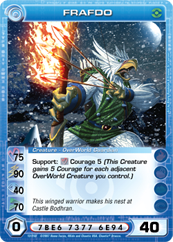
Frafdo2
Frafdo, an Overworld Creature

Here is a Creature, Frafdo to be precise. You can see the name of the creature at the top of the card. Also at the top of the card is the tribe symbol (on the left) and the card's rarity and the set it cam from (on the right).

Next is the picture of the card, it's pretty, but it doesn't do anything.

Right below the picture is a bar that gives the creatures... type? I guess would be the best way to describe it. You might not be able to read it, but Frafdo's says "Creature- Overworld Caretaker. This can affect many things, attacks, battlegear, mugic, even locations.

 The most important stuff is at the bottom of the card. On the left side are 4 numbers, each number is this specific card's value for the 4 different disciplines. In order from top to bottom is the

Courage (a red heart)
Power (a yellow lightening bolt)
Wisdom (a blue eye)
Speed (a green arrow... thing)

These attributes affect and are affected by a LOT of different things, battlegear, mugic, attacks, locations, other creatures.

Nauthilax, an Underworld Creature
Next to the stats is the box containing all of the creatures special abilities (the specifics of which will be talked about later)

Next to the abilities box is the elements which the creature possesses. Frafdo has no elements (none are colored in) while Nauthilax has the element of water, meaning water attacks do more damage when he uses them.

*Important*
Under the elements is the energy box. This is that specific scan of the creature's health. That means that 2 of the same card (2 Nauthilax's for instance) may have different energy and discipline scores. This is one of the coolest parts of Chaotic! You can have 2 cards that are the same creature, but one is vastly superior to the other. 

Right of the energy is the code that you use to get that specific card into your online collection, pretty straightforward.
Lastly is the mugic counters. This is how many mugic (points, sorta) the creature can use to pay for certain abilities and mugic. We'll get into that later.

Mahrrant, a Danian Creature
Their are 5 different tribes that a creature can come from that each have their own strengths, weaknesses, and strategies.

1. The Overworld: Shown by the blue colored cards, like Frafdo. The Overworlders are generally considered "the good guys" which is kind of unfair, but whatever. Overworlders tend to use the elements of water and earth more than anything else and tend to favor high wisdom and courage discipline scores. There are obviously Overworlders that use fire and air and there are Overworlders that favor power and speed. I'm just saying that most seem to follow that trend.

2: The Underworld: Shown by the red colored cards, like Nauthilax. The Underworlders are generally considered "the bad guys" because they are more confrontational than the Overworlders. Underworlders tend to favor the element of fire and tend to favor the discipline of power.

3: The Danians: Shown by the brown colored cards, like Mahrrant. The Danians are basically an ant hive. they are very reliant on being in a group, an ability called the Hive (more on that later) The Danians are like the Overworlders, tending to favor earth and water and courage and wisdom (courage especially).
Ailav, a Mipedian

4: The Mipedians: Shown by the sandy yellow colored cards, like Ailav. The Mipedians are the lizard creatures. They tend to favor the element of air and tend to favor the discipline of speed. The Mipedians are more reclusive creatures that tend to be fairly strong by themselves, but more on that later.

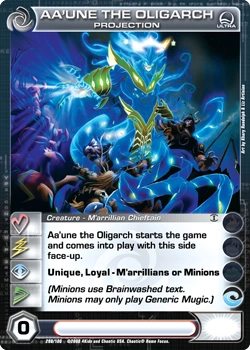
5: The M'arrillians: The fifth and final tribe are the M'arrillians. They are shown in greyish boxes and have a spiral icon in the top left corner. M'arrillians are interesting in that they focus a lot on controlling other tribes (Brainwashing) to achieve victory. Aa'une, the M'arrillian posted here, is the leader of the M'arrillians and one of the rarest cards out there.

C-Ma Aa-Une-the-Oligarch Side02The next blog will go more in depth on attack cards.

Chaotic: The Very Basics (The Types of Cards and Apprentice Rules)

The actual game of Chaotic could be played in more than one way with different amounts of cards.

There was both the Apprentice Rules, pretty simple, easy to start with.

And then there were the Master Rules, which explored the vast complexity that Chaotic could be.

Classically, you could play in either a 1v1, 3v3, or 6v6 situation. I'll explain what that means in just a second.
An example of a Creature card.

There were 5 different types of cards.

1: Creatures: Think monsters from Yu-Gi-Oh, but MUCH more important to each game. Each player would either get 1, 3 or 6 creatures, depending on the game.

2: Attacks: Imagine what each creature would do to damage
An example of an Attack card.
each the other. Each player would get a deck of 20 attack cards, with some other restrictions.


3: Battlegear: Each creature would get an item that they could use to help them win the battle gear, hence, battlegear.


4: Locations: The place where each other battles
would be fought. Each player got a deck of 10 cards
An example of a Location card.
An example of a Battlegear card.
An example of a Mugic card.


5: Mugic: Lastly, there were Mugic cards. The name combines magic and music (crazy right). You would have as many as you had creatures. They were cards you could use to do all sorts of things.


With all of the different kinds of cards, there was an almost endless possibility of combinations and decks to try.

Apprentice Rules
These rules were fairly simple. There were no mugic cards, or the Burst (which I'll get to later) in apprentice, It was just a straight fight between the creatures with only the battlegear, attacks, and location to help them.

Basically, to set up the game, you would place your creatures out in a pyramid shape facing your opponent, so that that the setup looked like this: (Sorry for the quality, it's the best I could find)
Imagine that annoying textbox wasn't in the way and quality was 100x better
You can imagine how a 1v1 and a 6v6 would look, just add or remove a diagonal line of creatures.

Each creature's battlegear would be placed faced down under the creature it's equipped to, and you would only reveal and use the abilities of the battlegear once a creature has started combat You would place your attack deck and location deck face-down to the side and draw 2 attack cards. At that point, you'd be ready to start the game. Decide who gets the first turn and it's time to begin!

Starting Combat

The player who's turn it is (we'll call them the active player) will start the game by flipping over the top card on their location deck. This location is where the fighting for that turn will occur. We'll get more in depth on Location cards in another blog, but the important part is that location's decide which creature gets to throw the first attack, the Initiative. The active player will select 2 creatures, one of their own to attack, and one of their enemies to defend. These creatures will participate in the fighting (most of the time) for that turn. The players will look at the Initiative to see who gets to throw the first punch.

The very basics of combat are that when it's your turn to attack, you will draw an attack card (so you have 3 in your hand on your turn) and then play an attack card. Deal however much damage the attack will deal and then it's the next player's turn. The creature that reaches 0 energy (the creature's health that's printed on the card) is destroyed and moved to the discard pile. Then the surviving creature, if it was the attacker, takes the defender's spot on the map, and if it was the defender, get's to stay in it's spot.

Those are the very, very basics of combat. Decide who's fighting, see who attacks first, draw a card, play a card, repeat until someone's dead. Very simple, not not even close to what the game has to offer in terms of strategy.

Once that fight is over, the active player may move his other creatures into open spaces before ending their turn. Then the other player flips over a new location card and the process continues until only 1 player's creature(s) are left on the board.

In the next blog, I'll talk about Creatures, the most important part of the game!